New Publication: SEN2NEON – Multispectral SR Validation Dataset

SEN2NEON: Enabling quantitative benchmarking of Sentinel-2 super-resolution for all multispectral bands

We’re pleased to share that our work, “SEN2NEON: Enabling Quantitative Benchmarking of Sentinel-2 Super-Resolution for all Multi-Spectral bands,” has been published open access by IEEE.

Sentinel-2 super-resolution has become an important research direction for Earth observation, but the field has long faced a fundamental limitation: for the 20 m and 60 m bands, there is no straightforward high-resolution ground truth. As a result, many studies rely on synthetic degradation protocols, where low-resolution inputs are generated by downsampling higher-resolution data. While useful, these protocols do not fully capture the radiometric and spatial characteristics of real Sentinel-2 observations.

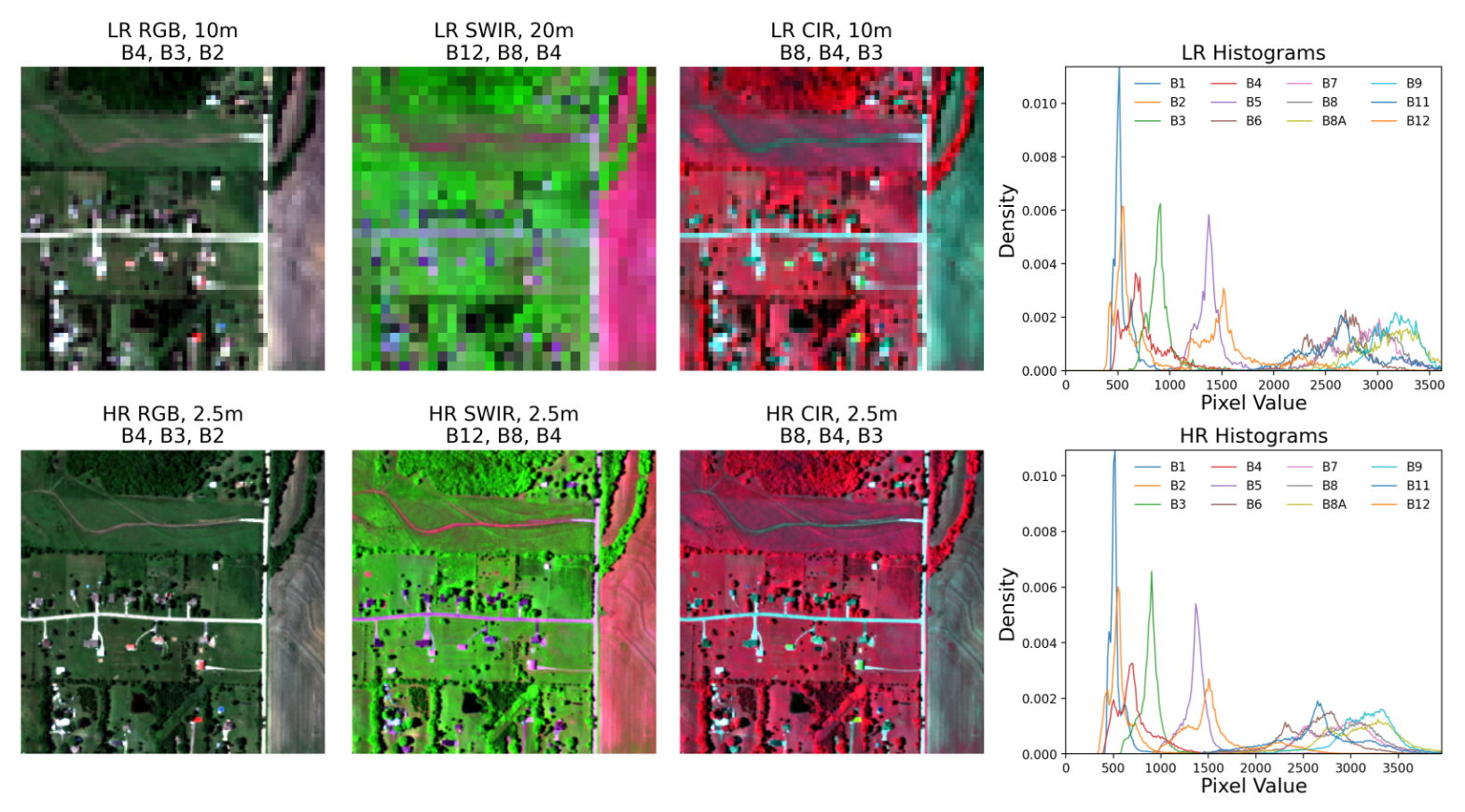
SEN2NEON addresses this gap by introducing a physically grounded benchmark dataset for Sentinel-2 super-resolution. It pairs real Sentinel-2 Level-2A reflectances with high-resolution reference data derived from AVIRIS-NG hyperspectral imagery, harmonized through sensor-aware spectral response convolution and radiometric correction.

What we built

  • SEN2NEON benchmark dataset: A cross-sensor dataset designed for quantitative Sentinel-2 super-resolution evaluation across all multispectral bands, excluding the cirrus band.
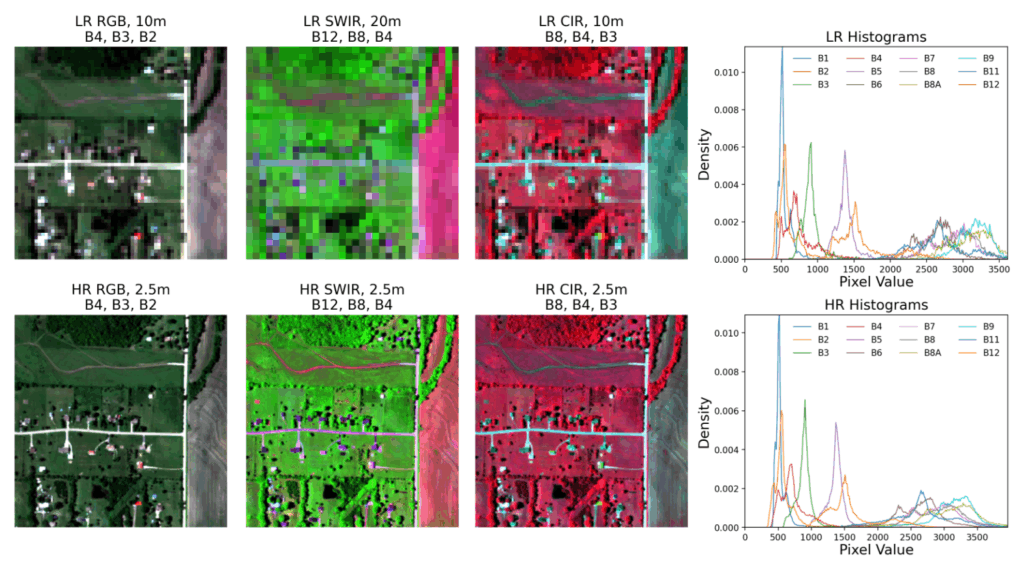
  • Real Sentinel-2 LR inputs: Instead of generating low-resolution inputs synthetically, SEN2NEON preserves the original Sentinel-2 observations as the LR data.
  • High-resolution AVIRIS-NG references: Hyperspectral AVIRIS-NG imagery is transformed into Sentinel-2-like reflectances at 2.5 m reference resolution.
  • Sensor-aware harmonization: We align AVIRIS-NG and Sentinel-2 through spectral response convolution and radiometric correction, producing physically meaningful LR–HR pairs.
  • Cross-dataset consistency analysis: We quantify harmonization quality using LR–HR resampling consistency metrics, enabling a more rigorous assessment of alignment between the real Sentinel-2 measurements and the high-resolution reference.

Results at a glance

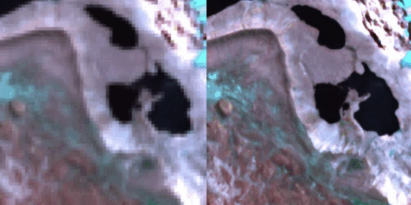
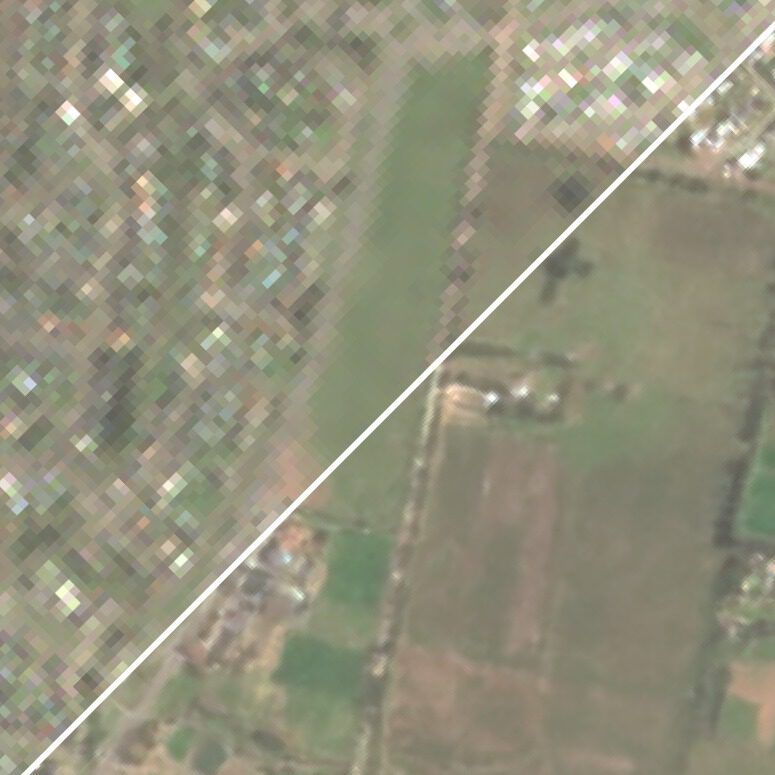
SEN2NEON provides physically aligned low- and high-resolution pairs for Sentinel-2 bands at their native S2 resolution and at 2.5 m reference resolution.

Compared to existing cross-sensor datasets, it offers:

  • Broader spectral coverage across Sentinel-2 multispectral bands.
  • A finer effective reference resolution.
  • Stronger consistency between LR Sentinel-2 observations and HR reference data.
  • A reproducible benchmark for evaluating super-resolution models under realistic sensing conditions.

By avoiding purely synthetic degradation, SEN2NEON enables a more meaningful evaluation of whether super-resolution models recover physically plausible high-resolution reflectance patterns rather than merely optimizing for artificial downsampling assumptions.

Why it matters

Super-resolution for Sentinel-2 is widely used in land-cover mapping, vegetation monitoring, water analysis, urban studies, and environmental change detection. However, without reliable high-resolution references, it is difficult to compare methods fairly or assess whether improvements are physically meaningful.

SEN2NEON helps address this by providing a benchmark that is:

  • Quantitative: Models can be evaluated against high-resolution references rather than only visually inspected or tested under synthetic degradation.
  • Physically grounded: The LR input is real Sentinel-2 data, while the HR reference is derived through sensor-aware harmonization.
  • Multispectral: The dataset supports benchmarking beyond RGB and 10 m bands, extending evaluation to the full Sentinel-2 multispectral setting, except for the cirrus band.
  • Transferable: The harmonization strategy behind SEN2NEON can be adapted to other multispectral satellite sensors, supporting broader development of physically consistent super-resolution benchmarks.

Toward better Sentinel-2 super-resolution evaluation

By combining real Sentinel-2 observations with harmonized high-resolution hyperspectral references, SEN2NEON provides a foundation for developing and comparing models that are not only visually convincing, but also radiometrically and spatially consistent.

🔗 Read the full article: SEN2NEON: Enabling Quantitative Benchmarking of Sentinel-2 Super-Resolution for all Multi-Spectral bands — IEEE Open Access

🔗 Access the Dataset: Github.com/SEN2NEON
Time-Series of NDVI development: Track NDVI over crop cycles and seasonality.

Recent Posts

New Publication: SEN2NEON – Multispectral SR Validation Dataset

We have published SEN2NEON, an opend ataset for all-band validation of Sentinel-2 Super-Resolution!

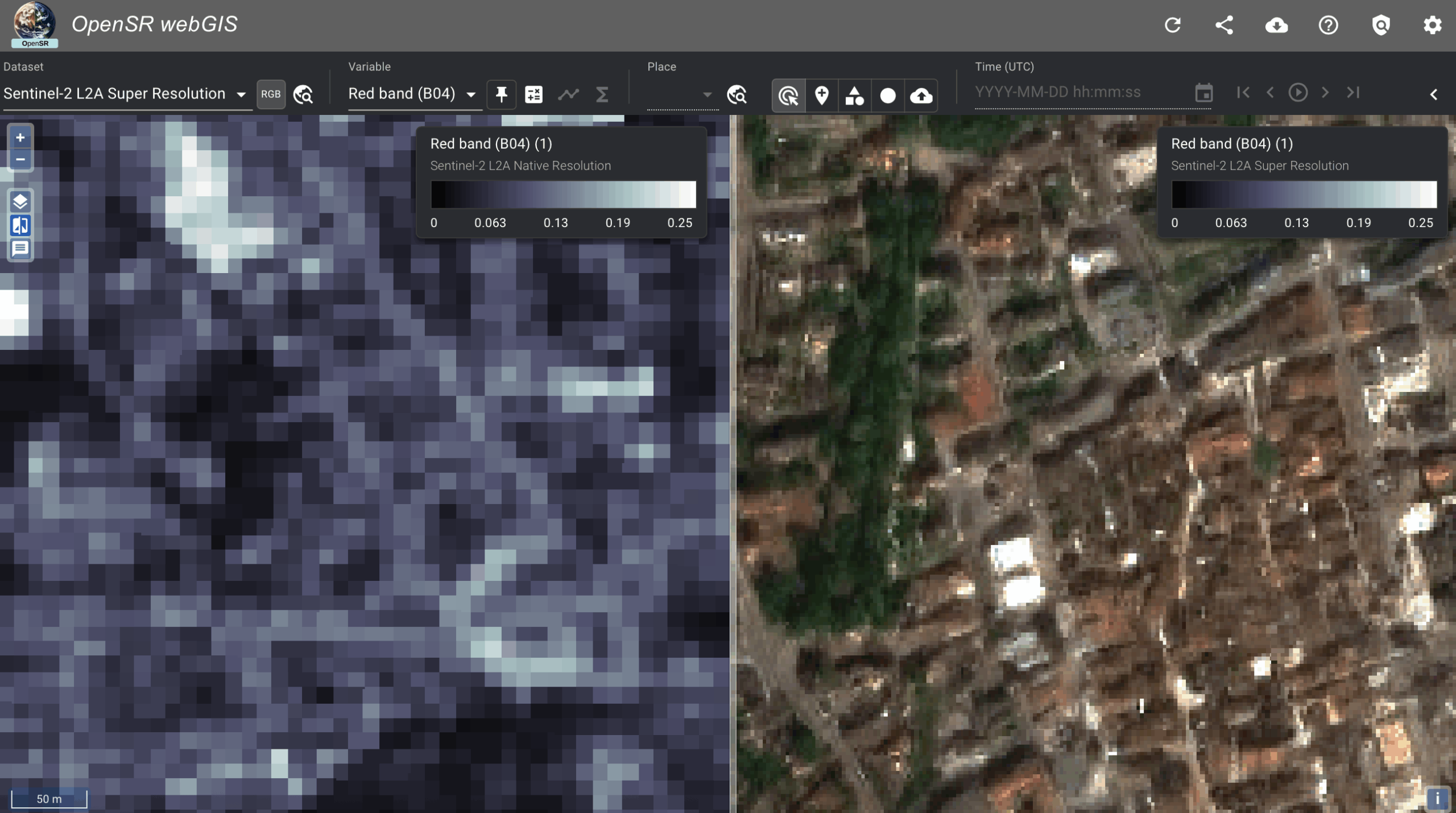
The New OpenSR WebGIS Viewer: Exploring Europe at 2.5m

Explore our new WebGIS viewer showcasing a Europe-scale 2.5 m super-resolved Sentinel-2 data cube generated with LDSR-S2 and directly comparable to the native 10 m imagery.

OpenSR-SRGAN – Modular Framework for Multispectral SR (Code and Publication)

OpenSR-SRGAN is our new open-source framework that makes GAN-based super-resolution easy, modular, and fully reproducible for multispectral satellite data. It lets researchers swap architectures, losses, and training strategies through simple configuration files—no code changes needed.

SEN2SR Integration in ArcGIS!

The ESRI Analytics Team has integrated our model into ArcGIS! Users can now easily and seamlessly use our models straight without coding, straight through their GIS software.

New Publication: NIR-GAN – Syntehtic NIR from RGB images

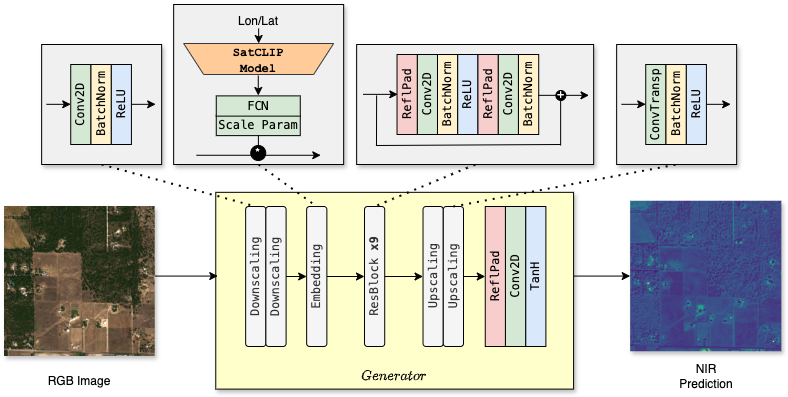
NIR-GAN: Synthesizing Near-Infrared from RGB with Location Embeddings and Task-Driven Losses We’re excited to share that our work, “Near-Infrared Band Synthesis From Earth Observation Imagery With Learned Location Embeddings and Task-Driven Loss Functions,” has been published open access by IEEE. Most remote sensing workflows depend on near-infrared (NIR) information—think NDVI/NDWI for vegetation and water—but many RGB-only archives simply don’t have it. NIR-GAN closes that gap by learning to generate a realistic NIR band directly from RGB, so practitioners can compute familiar indices and train multispectral models even when NIR isn’t available. What we built NIR-GAN (conditional GAN): An image-to-image model ...

OpenSR at the 4th IADF School: Luis and César Lead Sessions on EO Super-Resolution

Luis Gómez Chova and César Aybar represented OpenSR at the 4th IADF School in Benevento, delivering sessions on super resolution and EO machine learning.

No-Code SR Demo is now live!

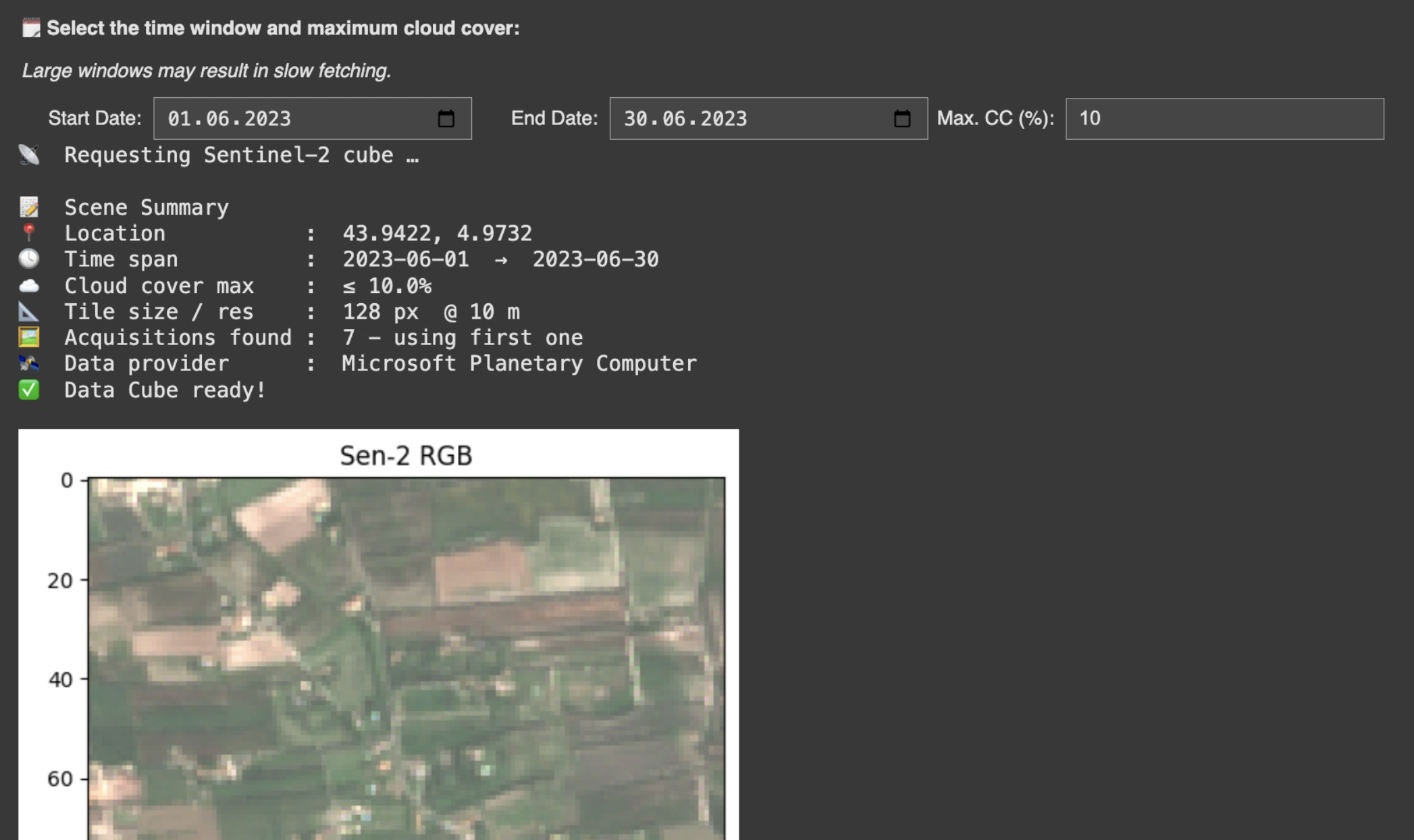
This demo, aimed at non-technical users, allows you to enter your coordinates and create a super-resolution product on your custom Sentinel-2 acquisition. Immediately judge wether SR can be useful for you application!

OpenSR Team @Living Planet Symposium

The OpenSR team joined ESA’s Living Planet Symposium 2025 to present our latest advances in Sentinel-2 super-resolution, dataset standards, and workflows. From latent diffusion models to FAIR-compliant data access with TACO, our tools aim to make high-resolution Earth observation more accessible and actionable.

New Release: OpenSR-UseCases Package

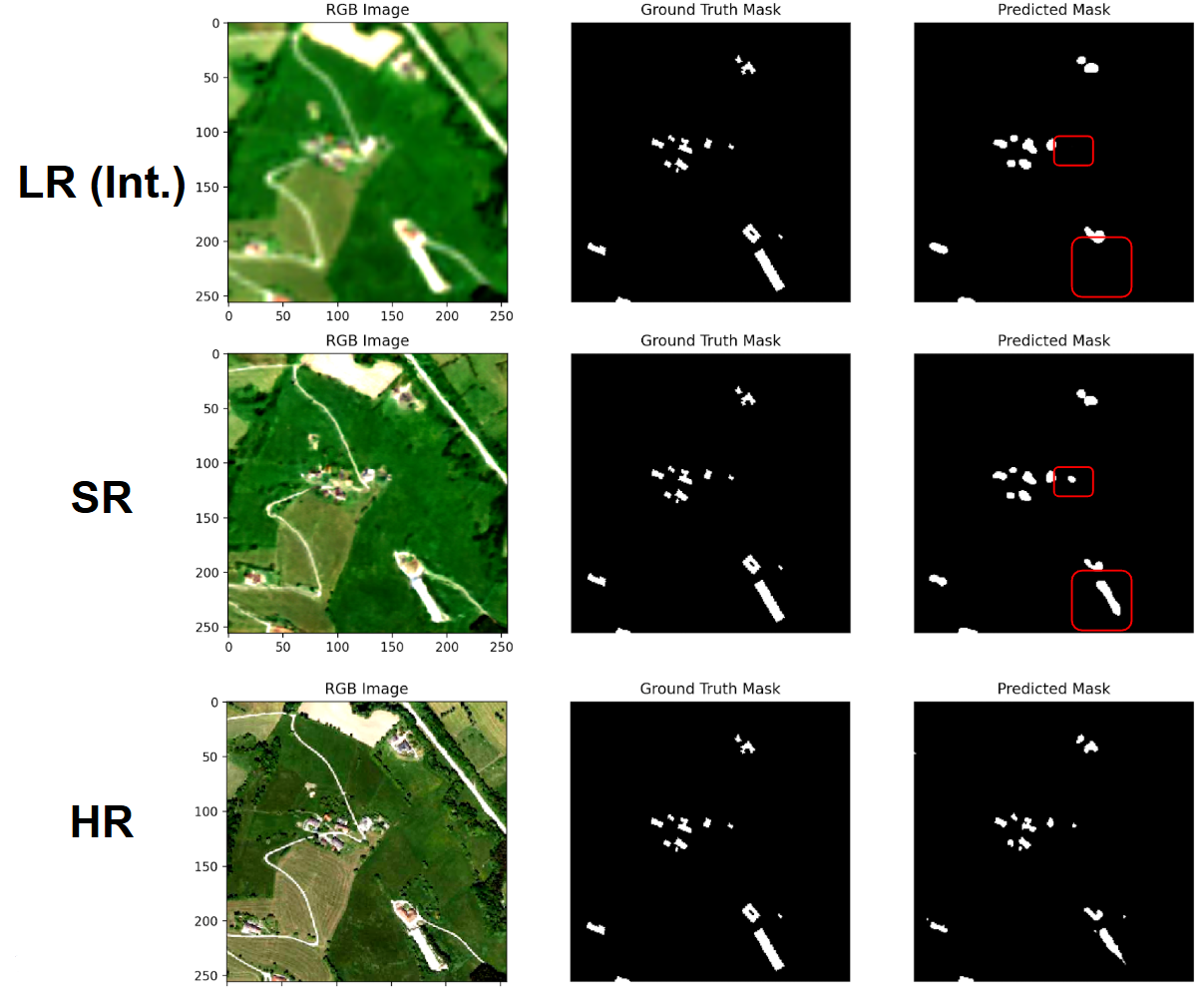
A lightweight validation toolkit to benchmark segmentation performance across low-, super-, and high-resolution imagery. Quantifies how well super-resolution models improve object detection and segmentation accuracy in real-world tasks. Ideal for researchers who want to go beyond visual inspection and measure actual downstream performance gains.

New Preprint: A Radiometrically and Spatially Consistent Super-Resolution Framework for Sentinel-2

We’ve published a new preprint presenting SEN2SR, a deep learning framework for super-resolving Sentinel-2 imagery with radiometric and spatial fidelity. The model leverages harmonized synthetic data, hard constraints, and xAI tools to achieve artifact-free enhancements at 2.5 m resolution.

RGB-NIR Latent Diffusion Super-Resolution Model Released!

Our Latent diffusion model, including weights, for the RGB-NIR bands of Sentinel-2 has been released.

New Publication: LDSR-S2 Model Paper

Our diffusion-based super-resolution model for Sentinel-2 imagery has been published in IEEE JSTARS! The open-access paper introduces a latent diffusion approach with pixelwise uncertainty maps—pushing the boundaries of trustworthy generative modeling in Earth observation.

SEN2NAIP v2.0 Released — A Major Boost for Sentinel-2 Super-Resolution

We’ve released SEN2NAIP v2.0, a large-scale dataset designed for training and validating super-resolution models on Sentinel-2 imagery. The dataset includes thousands of real and synthetic HR-LR image pairs, making it a cornerstone for future SR research in Earth Observation.

New Publication: SEN2NAIP published in ‘Scientific Data’

The dataset paper has been published in 'Scientific Data'.

The OpenSR team contributes to Flood Mapping for the Valencian Flash Floods

Our team at the University of Valencia has released an interactive satellite flood map of the recent Valencia flash floods, using Landsat-8 and Sentinel-2 imagery combined with a machine learning segmentation model. Leveraging super-resolution techniques, we enhanced Sentinel-2 data to 2.5m resolution, enabling more precise flood extent mapping for post-disaster analysis.